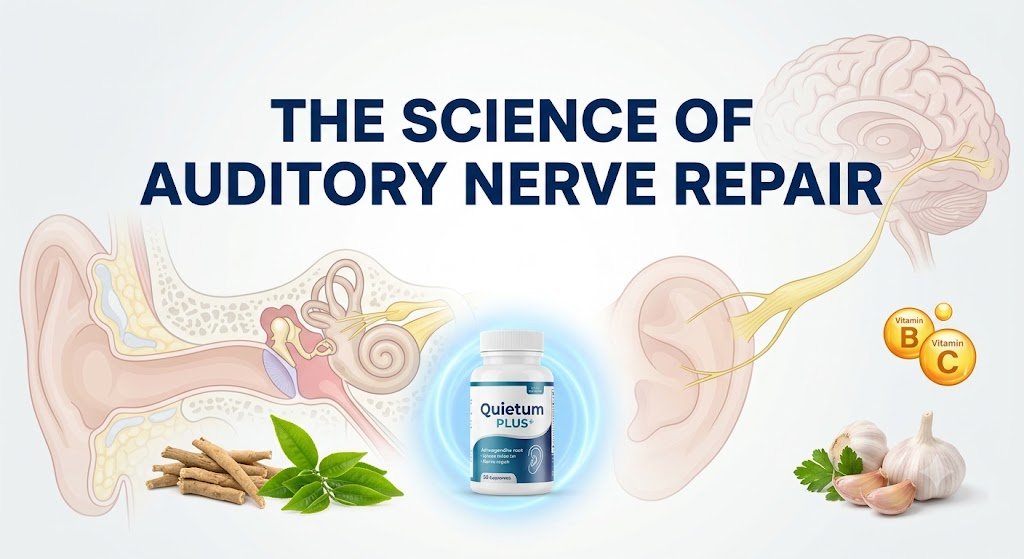
When people experience persistent ear noise—such as high-pitched ringing, clicking, or steady buzzing—the default reaction is often to assume the problem lies entirely within the ear drum. However, modern neuro-audiology reveals that auditory processing relies just as heavily on the integrity of the auditory nerve pathway.
Understanding how sound signals travel, why neural connections degrade, and how targeted botanical nutrition supports cellular repair is crucial for anyone seeking long-term auditory clarity. For comprehensive details on natural auditory formulas, visit the official Quietum Plus page
Understanding the Auditory Nerve “Wire”
The human auditory system relies on a seamless sequence of biological events:
- Vibrational Input: Sound waves travel through the outer ear canal to vibrate the eardrum.
- Cochlear Conversion: Microscopic hair cells inside the fluid-filled cochlea convert mechanical vibrations into electrical impulses.
- Neural Signal Transmission: The auditory nerve acts as a biological “wire,” delivering these electrical signals directly to the brain’s central auditory cortex.
When this neural pathway is fully healthy, the protective myelin sheath surrounding auditory nerve fibers allows electrical signals to jump quickly from node to node without interference or static.
What Causes Auditory Signal Degradation?
When the myelin sheath or cochlear hair cells experience damage, electrical signaling breaks down. Common causes include:
- Neuro-Inflammation: Chronic systemic inflammation irritates delicate nerve fibers, causing erratic firing.
- Microvascular Insufficiency: Reduced blood supply to the inner ear deprives nerve cells of oxygen and key metabolic nutrients.
- Oxidative Stress: Free radicals generated by loud noise exposure and aging accelerate cellular decay in the inner ear.
When distorted signals reach the brain, the central auditory cortex attempts to compensate for missing sound frequencies by hyper-activating its neural networks. This overcompensation creates internal phantom sounds, commonly known as tinnitus.
Nutritional Strategies for Auditory Nerve Support
Restoring quiet clarity requires addressing the structural integrity of the nerve pathways. Clinical literature points toward several key mechanisms for neural support:
1. Soothing Neural Inflammation
Botanicals rich in adaptogenic compounds—such as Ashwagandha and Mucuna Pruriens—help calm overactive nerve signaling. According to research archived on NCBI / PMC
, adaptogens help reduce stress-induced neuro-inflammation and protect delicate nerve tissues.
2. Enhancing Micro-Circulation to the Cochlea
Vasodilating amino acids like L-Arginine stimulate nitric oxide production, expanding micro-vessels to supply fresh oxygenated blood directly to the inner ear. As demonstrated in clinical studies on PubMed
, healthy microvascular blood flow is essential for inner ear tissue preservation.
learn more – quietum plus
3. Rebuilding the Myelin Sheath
Essential trace minerals and vitamins—particularly Zinc, Vitamin A, and B-Complex vitamins—play a fundamental role in maintaining nerve cell membranes and supporting neurotransmitter synthesis. You can explore how these nutrients work synergistically in daily formulas on https://quietumplus.us/
.
Final Thoughts
Auditory decline and persistent ear noise do not have to be accepted as inevitable parts of aging. By supporting inner ear circulation, combating cellular oxidative stress, and nourishing the protective sheaths of your auditory nerves, you can help preserve daily sound clarity and regain peaceful quiet.
To learn more about natural ingredient blends designed for auditory nerve support, visit Quietum Plus online
.
Pingback: Boost Inner Ear Circulation for Hearing Clarity
Pingback: Sustaining Hearing Acuity: The Quietum Plus Plan
Pingback: Tinnitus Causes & Natural Auditory Support | Quietum Plus Guide